
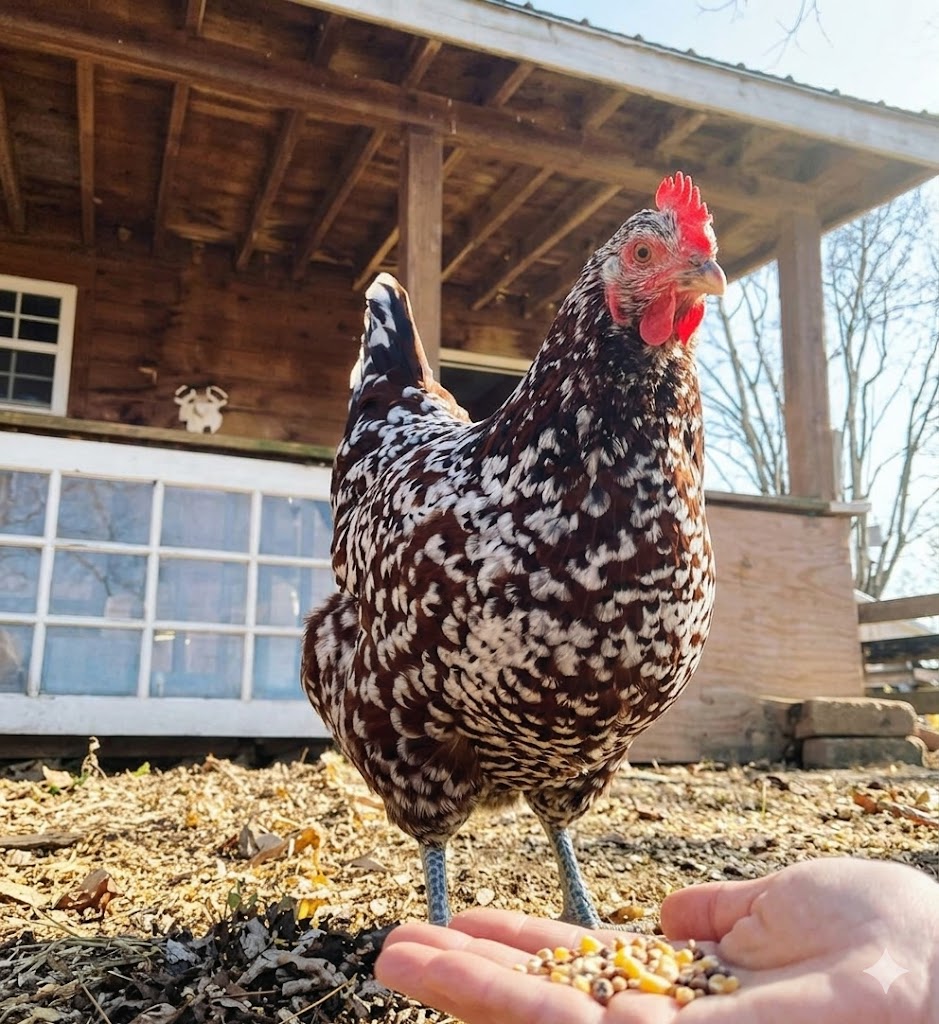

Luvenia, a Speckled Sussex hen, was one of the few remaining chickens we transported with us down to Tennessee when OMI moved from Washington in 2021. She had been dumped in a park with some of her “spent laying hen” sisters, which is a very sad but common practice. Chickens who are bred specifically for their egg-laying capacity will start decreasing their production as they age. Their lifespan is actually quite a bit longer than their length of laying time, and people who buy chickens for their backyards grow weary of taking care of a bird who doesn’t give them breakfast any more. They are discarded in a variety of ways, but one of them is to dump the birds in the wild to leave them to get eaten by predators.
When we took in Luvenia, we did not know how old she was, or all that she had already survived before she came to us. But we do know the most important part of her story: she made it to sanctuary. She was safe here. She was cared for here. And she was loved here for the rest of her life.
Backyard chicken keeping is often framed as a kinder alternative to factory-farmed eggs, where hens bred for extremely high output may endure painful practices like debeaking and extreme crowding. Commercial laying hens are pushed to produce at extraordinary levels (over 280 to 320 eggs per year) before being labeled “spent” and sent to slaughter.
But “backyard” does not mean cruelty-free. Speckled Sussex hens like Luvenia are often described as “good layers” too, expected to produce around 200 to 240 eggs a year under ideal conditions. Like their factory-farm counterparts, hens like Luvenia have still been selectively bred to lay far more eggs than their wild ancestors ever would have. A red junglefowl, the ancestor of modern chickens, would lay only small seasonal clutches, not hundreds of eggs year after year. The kind of reproductive burden domesticated chickens endure takes a real toll on the body. So while backyard systems may look gentler than industrial ones, they are still built on the same underlying idea: that a chicken’s worth is tied to what she can produce for humans.
And for every hen brought into egg production, there is a male chick whose life is considered expendable because he will never lay eggs. In industrial systems, male chicks are routinely killed shortly after hatching. In backyard settings, roosters are often abandoned, passed around, neglected, or killed once they become inconvenient. The violence may look different depending on the setting, but it is rooted in the same logic.
Luvenia’s life mattered because she was never just what she could produce. She was not an egg producing machine. She was not “spent.” She was someone. However her life began, she got to live out her remaining years in a place where she was seen as an individual, not a unit of output.
And we are so grateful she got to have that life with us, and that we got to know and love her.