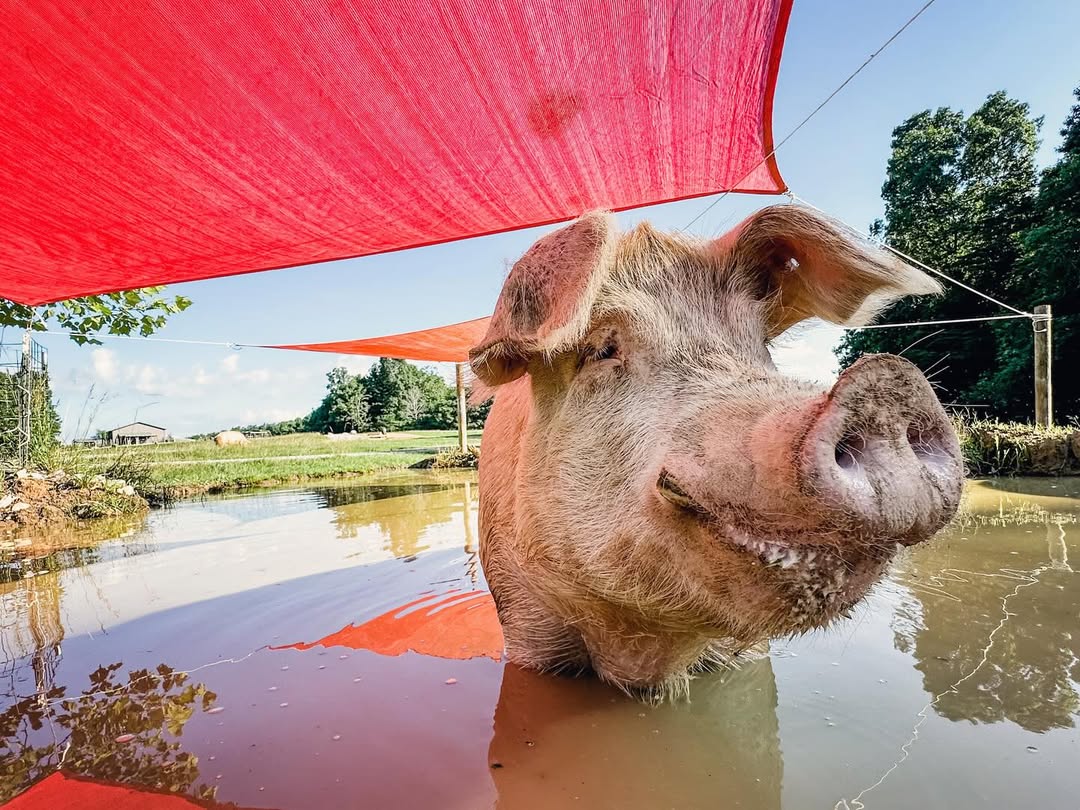
Maple is a very large lady pig—more than 700 pounds—and she has been recovering from surgery to repair a cranial cruciate ligament (CCL) tear in her stifle joint. In human terms, the stifle is similar to the knee, and the cranial cruciate ligament performs a role much like the anterior cruciate ligament (ACL) in the knee.
When we say that Maple is doing fantastic, we do not mean that her recovery has been simple.
Her surgery was successful. But surgery was only the beginning.
A Question Without an Easy Answer
At Maple’s follow-up appointment at the University of Tennessee, we were worried. She was walking and putting weight on the affected leg, but her mobility was still far from where we hoped it would be.
Her surgeon examined the joint, moved the leg through its range of motion and assessed the repair. He believed the surgery had held. The next challenge was rehabilitation.
Unfortunately, there is not an established handbook for rehabilitating a 700-plus-pound pig after this kind of injury. Maple’s size, strength and individual needs mean that exercises used for a smaller animal cannot simply be copied and expected to work.
We have experience with long-term rehabilitation. Some of Maple’s exercises are similar to those we used with Abby, another Babe who needed mobility support. But Abby is much smaller than Maple. This was not an apples-to-apples situation.
Maple needed a program built for Maple.
Building Maple’s CCL Rehabilitation Program
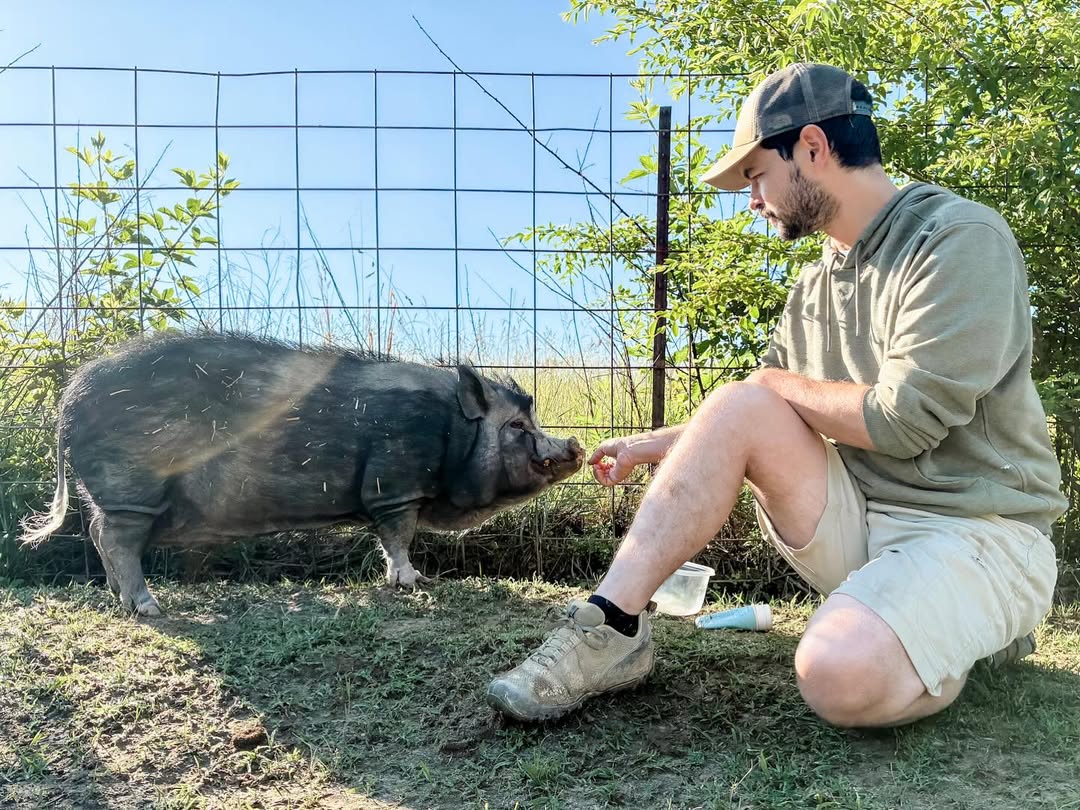
One of our animal caregivers Christa took on Maple’s rehabilitation as a special project. She has worked patiently to identify exercises Maple can perform safely and to understand which movements encourage her to use and strengthen the recovering leg.
The team watches for changes that might seem small but carry real meaning. Is Maple willing to lie on the affected side? Can she use that leg when she pushes herself up? How can we encourage her to step with it instead of compensating with the rest of her body?
Maple now participates in physical therapy twice a day. This has been happening every day for months.
Recovery at this scale is not one dramatic moment. It is repetition. It is observation. It is trying something, recording the result and making careful adjustments. It is showing up for another session in the evening after completing one that morning.
Most importantly, it is allowing Maple to progress at Maple’s pace.
This is one of several exercises Christa does with Maple. In other sessions, she folds the mat to create a small step, encouraging Maple to lift and place her leg as she steps onto it. The mat can be adapted for different exercises that support Maple’s strength, balance, and mobility.
Turning One Caregiver’s Knowledge Into a Team Practice
Developing an effective exercise is only part of the work. Every caregiver needs to understand how to perform it consistently.
Christa has shared what she has learned with the rest of the animal-care team. We discuss Maple during our caregiver meetings, enter information into our animal-care software and take regular videos so we can evaluate her movement over time.
We ask very specific questions of one another: How are you encouraging her to make that step? What position are you using? What response are you seeing?
That level of detail matters. Maple should receive the same thoughtful, intentional care regardless of which caregiver is working with her that day.
Care That Continues After The Operation
Medical stories are often told as if surgery were the conclusion: an animal is injured, a surgeon repairs the injury and the story ends with a successful procedure.
A successful operation provides an opportunity to heal. Rehabilitation helps an animal make use of that opportunity. It requires communication, documentation and an enormous investment of time from both the caregivers and the animal.
Maple’s progress has also depended on our relationship with the University of Tennessee. We remain in contact with her veterinary team, sharing updates and asking questions as her recovery evolves. They provide their expertise, while our caregivers contribute the detailed knowledge that comes from living and working with Maple every day.
Neither part can replace the other. Her care is strongest when the sanctuary and veterinary teams work together.
The Work You May Never See
Maple’s rehabilitation is difficult to capture on social media. We can share an occasional video or progress update, but we cannot show every therapy session, every caregiver conversation or every entry in her medical record.
Rescue may bring an animal through the gate, but the promise we make extends far beyond arrival. It includes the ordinary days, the complicated medical cases and the long recoveries with no guaranteed outcome. It includes adapting when there is no established roadmap and continuing to search for what gives an individual resident the best possible quality of life.
Twice each day, Maple and her caregivers do that work together.
Her recovery is still a process. We will continue to observe her, learn from her and adjust her program as her needs change. But today, Maple is moving forward—and every deliberate step is worth celebrating.
Caring for a Pig after CCL Repair Surgery?
If you are caring for a pig with a cranial cruciate ligament injury, preparing for CCL repair surgery or navigating the rehabilitation process afterward, we invite you to reach out.
There is limited information available about CCL rehabilitation in large breed pigs, and every animal’s injury, mobility and medical needs are different. A rehabilitation plan should always be developed with a qualified veterinary team. While we cannot provide veterinary advice, our caregiving team would be happy to share what we have learned through Maple’s individual case, including the physical therapy approaches we have tried, the ways we monitor her mobility and the systems we use to document her progress.
We also welcome inquiries from veterinarians and veterinary students interested in following Maple’s recovery or learning from the observations, videos and records generated through her long-term rehabilitation program. We hope that sharing Maple’s experience can contribute to better outcomes for other large breed pigs facing orthopedic injuries and mobility challenges.