
Duroc
Pigs
Red coats, folded ears, and bodies shaped by generations of human choices. Getting to know Duroc pigs means looking at that history and making room for the individuals whose lives extend far beyond a breed description.
Red pigs with
an American history
A red pig with a name borrowed from a racehorse: the Duroc story begins with two nineteenth-century American populations. New Jersey’s Jersey Reds were large and rangy; New York’s Durocs were smaller and more compact. Breeders began systematically crossing them in the 1860s, and the American Duroc-Jersey Association formed in 1883.1, 2
The name goes back to 1823, when Isaac Frink obtained a red boar from Harry Kelsey in New York. Kelsey owned a celebrated trotting stallion named Duroc, and the pig received the same name. Long after that horse’s lifetime, the name remains attached to generations of red pigs.1
Today, Durocs are recognized by their forward-folding ears and reddish coats, ranging from pale gold to deep mahogany. Those familiar features tell one part of their story. The rest belongs to the individuals beneath them.1, 2

Bred to grow quickly.
Cared for across a lifetime.
Durocs became widely used in commercial breeding because people selected them for rapid growth, muscular bodies, and traits valued in pigs raised for their flesh. They are often used as a “terminal sire”: a father whose offspring are intended to be slaughtered rather than kept as the next generation of breeding animals. Durocs are commonly crossed with Large White and Landrace pigs in that system.1, 2
That vocabulary describes what an industry wants from a pig. It says nothing about the life that pig might choose: familiar companions, room to explore, a comfortable resting spot, and the chance to grow old.
At sanctuary, the purpose of care changes. We learn the history of the bodies in front of us, then build a life around the needs and preferences of the individuals who inhabit them.
A breed name.
A whole lot of personality.
Confident? Curious? Particular about the daily routine? At OMI, those words mean more when we can put a face to them. Our Duroc directory includes pigs with mixed ancestry, and each resident brings a personality shaped by far more than a breed label.
Rae arrived after being found wandering a rural neighborhood in winter. Once she settled into sanctuary life, she joined Charity in the Feral neighborhood. OMI’s account of her routine includes breakfast visits to the Garden Houses, followed by afternoon naps back in her own neighborhood. A pig who once had nowhere safe to go now has places to be.5
Jolene brings a different kind of presence. Rescued with her family in 2018, she is described by her caregivers as a dominant female in her herd and lives alongside family members in the Northwest neighborhood. Her story is about relationships and a life shared with others, not simply a red coat.8
Getting to know these pigs means noticing who they seek out, where they feel comfortable, and how they choose to spend a day. No breed description can do that work for us.
Duroc pig health and care
Comfortable movement, places to cool off, good food, and pig companionship all belong in lifelong care. These are needs shared by pigs of many breeds. Each resident’s age, body, experiences, and changing health guide the care they receive.
Looking after joints and mobility
Research in growing Duroc pigs has documented joint-cartilage lesions and inherited differences in joint health and leg soundness. The study followed a closed breeding population over six generations; it tells us about those growing pigs rather than lifetime outcomes at sanctuary.7
Safe footing, comfortable bedding, and easy access to food, water, and shelter help support daily movement. Caregivers watch for changes in gait, posture, and willingness to get up. A new limp deserves veterinary attention, with care adapted to each resident’s needs.3, 4
Shade, water, and a good wallow
Warm weather makes access to shade, fresh drinking water, and cooling spaces essential. A wallow gives pigs a way to cool down while enjoying a natural behavior. Dry resting areas and good ventilation matter too.3
Rooting, exploring, and resting near compatible companions are part of a good life. A resident’s surroundings should offer opportunities to make those everyday choices.3
Care that follows the individual
Preventive care belongs alongside day-to-day comfort: regular health checks, appropriate nutrition, parasite management, and a veterinary plan tailored to the resident. Rae’s arrival at OMI included vaccines, parasite care, and spay surgery at the University of Tennessee Veterinary Medical Center.5, 6
Jolene’s care took a different path. In 2020, she developed a severe spinal infection and was successfully treated at New Bolton Center. Her experience is an individual medical history, not a diagnosis attached to the Duroc name.8
Caregivers keep learning what is normal for each pig, so changes in appetite, activity, or behavior receive attention early.6
Meet the individuals
A favorite place to nap, a familiar friend, a particular way of greeting the day. Meet the Sanctuary Babes listed in our Duroc directory and discover the individual lives behind the breed name.


Remembering those who have passed
Their lives remain part of this sanctuary. Read the memorials of those listed in our Duroc directory and remember the friendships and experiences they shared with us.


Look beyond the breed
Artificial selection
Explore how human choices shape animals’ bodies and lives.
The Learning Center
Follow your curiosity and keep learning about the animals behind the labels.
Caring for a pig?
Pig School offers free support from Odd Man Inn’s animal caregivers for sanctuaries, micro-sanctuaries, and private homes caring for farmed animals.
Duroc People
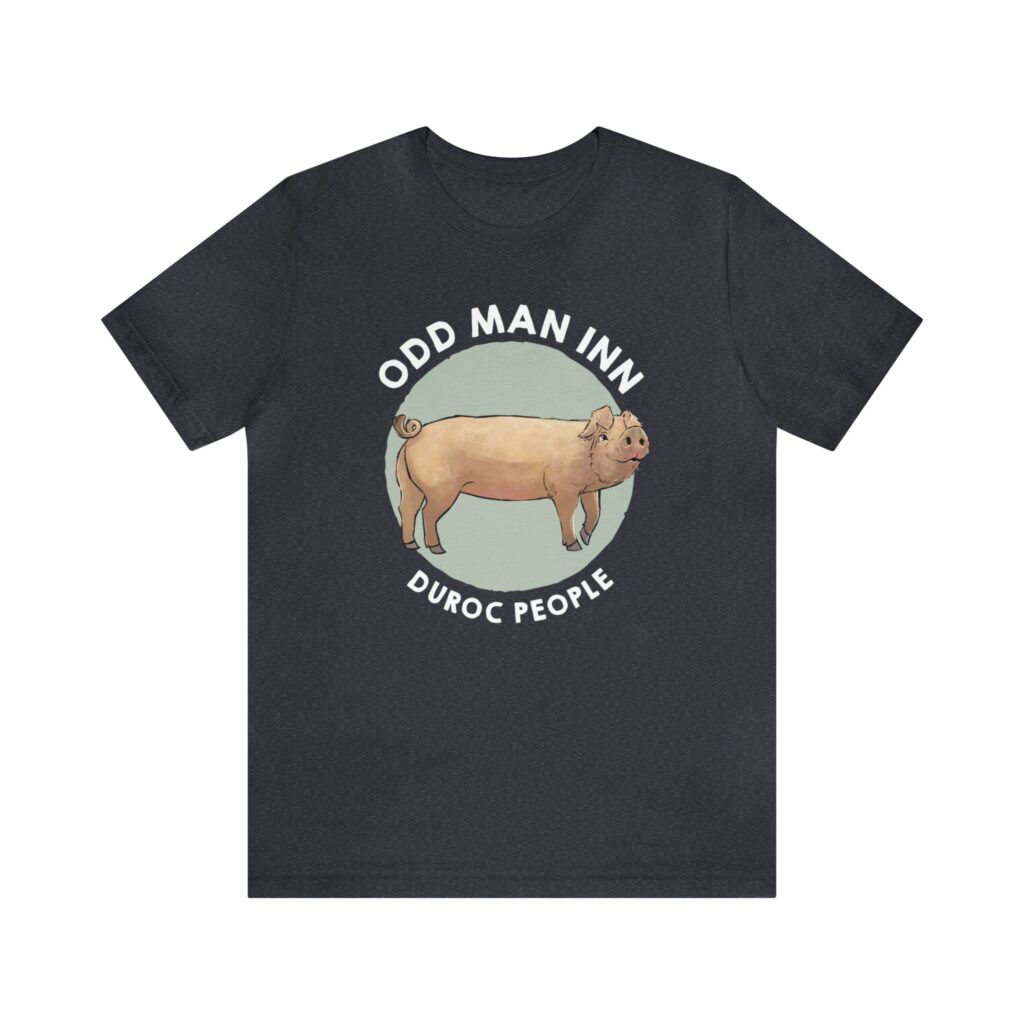
For the people who love these pigs. Shop our Duroc People tee in the Odd Man Inn store, featuring original art by vegan artist Mor Spicer.
- National Swine Registry: About Duroc. Breed history, appearance, and documented commercial selection priorities.
- NSW Department of Primary Industries: Breeds of pigs, Duroc. Origins, physical traits, and selective breeding.
- The Open Sanctuary Project: Creating a Good Home for Pigs. Housing, cooling, footing, and social needs.
- The Open Sanctuary Project: Additional Care Recommendations for Older Pigs. Mobility and changing care needs with age.
- Odd Man Inn: Rae. Rae’s veterinary care, arrival, and life at sanctuary.
- The Open Sanctuary Project: Introduction to Pig Care. Individualized preventive care and daily observation.
- Fukawa et al. (2000): Estimation of Genetic Parameters on Leg Score and Joint Cartilage Lesion Scores in a Closed Population of Duroc Pig. Six-generation study: 1,383 pigs assessed for leg weakness and 174 examined for cartilage lesions around 90 kg. Genetic relationships do not establish rapid growth as the cause of every joint problem.
- Odd Man Inn: Jolene. Her rescue, family relationships, herd role, and treatment for a spinal infection.
Images: Rae and Jolene, Odd Man Inn media library. Care guidance in this guide concerns pigs generally; resident stories describe individual experiences.