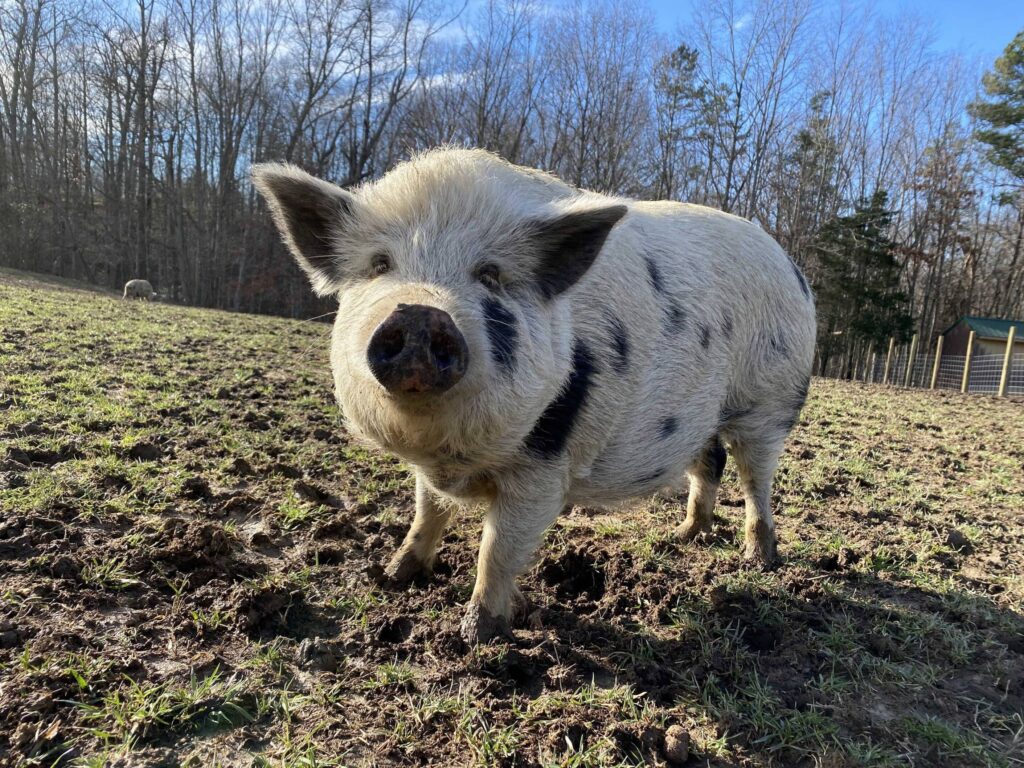
“Feral” describes pigs living outside human care and their descendants—not a single standardized breed. In the United States, the broader wild-pig population includes descendants of domestic pigs, introduced Eurasian wild boar, and mixtures of the two. The label alone cannot tell us an individual pig’s ancestry.1
Their appearances vary, too. Some have coarse coats and leaner bodies that resemble wild boar; others look more like familiar domestic pigs. Bristles, coat color, and body shape are not a genetic test.2
Nor does the label mean every resident was born in the wild. Anita was born here to Momma Memphis under the property’s former administration. She still chooses the company of her family.3
Anita was born here. A category is not a complete life story.
HUMAN CHOICES
Human choices brought them here.
People brought domestic pigs to North America to raise and kill for their flesh. Escaped animals and free-ranging herds established populations beyond human care. People later introduced Eurasian wild boar for hunting, and subsequent releases and movements helped spread wild pigs into new areas.1, 4
This history begins with human decisions—not with pigs choosing to become an ecological problem.
Life outside a commercial breeding program brings different pressures from breeding for production. Research in the Great Smoky Mountains has found evidence of adaptation within a population of mixed domestic-pig and wild-boar ancestry. Feralization is not a simple rewind to an untouched ancestral animal.5
A wild-looking coat is not a guarantee of good health. Care means noticing how each pig moves, respecting their boundaries, and making veterinary support possible without treating fear as misbehavior.
What our caregivers see
At Odd Man Inn, our caregivers generally see fewer mobility problems among pigs in our Feral category than among our larger commercial-breed pigs.
That is an observation from our own care experience—not a controlled study or proof of a single genetic cause. Every pig still deserves attention to their comfort, movement, and changing needs.
Respect is part of healthcare
Some residents welcome touch; others do not. Martin Luther’s caregivers respect his “no touch” preference and work with our University of Tennessee veterinary partners when handling is necessary.6
Dalai Lama also needs extra support for hoof and tusk care. Good care adapts to the pig—not the other way around.7
Compassion does not require denial
Free-ranging pigs can damage native vegetation, disturb soil and waterways, and prey on wildlife. Those impacts are real. So are the lives of the pigs themselves. At sanctuary, we can acknowledge ecological harm without reducing an individual to a label or treating their suffering as unimportant.4, 8
FERAL LIFE AT ODD MAN INN
Meet the individuals
Charity’s confidence. Anita’s family bonds. Silico’s leisurely naps. Each resident brings their own friendships, habits, and boundaries. Get to know the pigs behind the category.3, 9, 10